BLACK ANGELS:
WHOLE NEW WORLD
War, violence, and conflict have accompanied humanity throughout its history. Civilisations rise and fall, borders change, technologies transform our lives — yet certain patterns continue to return. How much do we really learn from the past, and what kind of future are we creating?
Written at a the height of the Vietnam War, George Crumb’s Black Angels reflects on the horrors of war, and in Crumb’s own words, “portrays a voyage of the soul… Departure (fall from grace), Absence (spiritual annihilation), and Return (redemption)”. In Black Angels: Whole New World, Sonar Quartett invites the listener to embark on an expanded ‘voyage of the soul’, to reflect on where we have come from, where we stand today, and where we are heading as a species.
Using the internal structure of Crumb’s Black Angels — based on numerology around the traditionally sacred numbers 7 and 13, and around three songs of lamentation for the dead — we expand outwards, looking deep into our history, and deep into the future. We reflect on our current relationship with conflict and death, and how it connects us to the past and into the future. With Crumb’s Black Angels as the central mirror, we reference conflicts throughout history — both inter-societal and between nations — and ideas such as cyclical time, and the connection between singing and weeping.
With works by Hildegard von Bingen, Björk, FKA twigs, Olivier Messiaen, Jlin, Samuel Barber, John Cage, Radiohead, Vangelis (the film Blade Runner), Kraftwerk, and SOPHIE, we reflect on Crumb’s movement subtitles — “Ancient Voices”, “Lost Bells”, “Pavana Lachrymae”, “Sarabande of Obscure Death”, “God Music”… We cross time, continents, and genres, even venturing into the galaxies.
Music cannot change the world, but it can help us process what is happening. History is cyclical and endless. Time is cyclical and endless. Can we escape this endless spiral, or will we ultimately destroy ourselves? These questions are as valid and urgent now as they have ever been.
In the immortal words of Blade Runner’s Roy Batty:
“I've seen things you people wouldn't believe.
Attack ships on fire off the shoulder of Orion.
I've watched C-beams glitter in the dark, near the Tannhäuser gate.
All those moments will be lost in time, like tears in rain.”
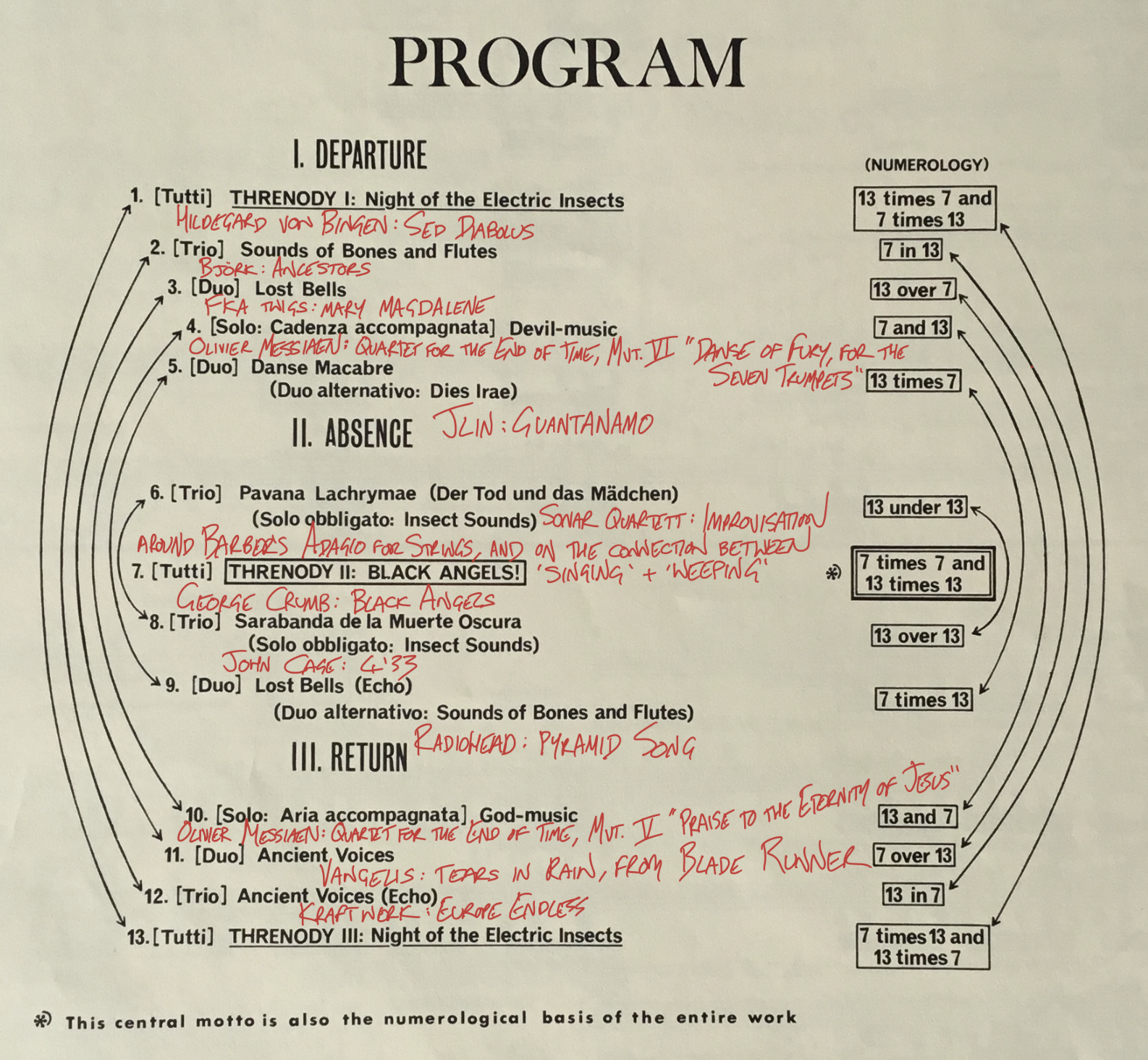
PROGRAM
all works arr. Sonar Quartett, except for Black Angels
1. Hildegard von Bingen: Sed Diabolus
[Black Angels subtitle:] “THRENODY I: Night of the Electric Insects”
Text: “But the devil in his envy, mocks
Thus leaving no work of God untouched”.
2. Björk: Ancestors
“Sounds of Bones and Flutes”
Reaching deep into our past, to our ancestors.
3. FKA twigs: mary magdalene
“Lost Bells"
A reflection on societal power imbalances which resonate throughout history. Here, specifically about the place of women in society, but which can also apply to any marginalised or oppressed section of society.
4. Olivier Messiaen: Quartet for the End of Time, Mvt. VI “Dance of Fury, for the Seven Trumpets”
“Devil Music”
Famously written and premiered during Messiaen’s time as a prisoner in a Second World War concentration camp, Quartet for the End of Time’s connections with conflict and human transcendence are inescapable. The first six of the seven trumpets of the Bible each bring death and destruction to the world. The seventh brings peace, and is what we are all furiously dancing for, but which never sounds.
5. Jlin: Guantanamo
“Danse Macabre”
Jlin’s dark, driving beats have always held something of the Danse Macabre. Here she marries this darkness with the subject matter of Guantanamo Bay, the infamous US detention camp for terror suspects which rose out of the terror attacks of 9/11, which became a symbol of injustice, brutality, torture, and utter disregard for humanity and human rights.
6. Sonar Quartett: improvisation around Barber’s Adagio for Strings, on the connection between ‘singing' and ‘weeping’
“Pavana Lachrymae” (‘Tears’)
Since it’s premiere, Barber’s Adagio has been used extensively in the West in moments of public mourning, such as after 9/11, at the funeral of JFK after his assassination, and at the Berlin Philharmonic’s European Concert for Coronavirus victims. Additionally, it was one of few pieces to reach across the divide and to be played in Russia during the Cold War.
Our improvisation will draw on this link to ‘mourning’, along with the connection between singing and weeping, two processes which are physically linked in the human body. To illustrate: begin to sing a note very quietly. The feeling you experience is the same as when you begin to weep.
7. George Crumb: Black Angels
“THRENODY II: BLACK ANGELS!”
8. John Cage: 4’33”
“Sarabanda de la Muerte Oscura” (‘Obscure Death’)
The mirror of singing and weeping is silent reflection. Death is silence.
9. Radiohead: Pyramid Song
“Lost Bells (Echo)”
Pyramid Song was premiered at the 1999 Tibetan Freedom Concert in Amsterdam. Lyrically and musically, it was inspired by an exhibition of ancient Egyptian underworld art, and ideas of cyclical time.
10. Olivier Messiaen: Quartet for the End of Time, Mvt. V “Praise to the Eternity of Jesus”
“God Music”
The mirror of Messiaen’s Dance of Fury for the Seven Trumpets. Maybe now we can try to sound the seventh trumpet. Maybe now we can try to reach the ‘Eternity of Jesus’.
11. Vangelis: Tears in Rain (from the film Blade Runner)
“Ancient Voices”
Taking these ideas of cyclical time and mirroring the ‘lost bells’ of ancient voices: the mirror of our ancestors, looking into the future.
“I've seen things you people wouldn't believe. Attack ships on fire off the shoulder of Orion. I've watched C-beams glitter in the dark, near the Tannhäuser gate. All those moments will be lost in time, like tears in rain.”
12. Kraftwerk: Europe Endless
“Ancient Voices (Echo)”
Cyclical time, endless time. The endless repetitions across human history.
13. …
“THRENODY III: Night of the Electric Insects”
Left blank to allow us all to write our futures. Which path will we choose going forward? It’s up to us.